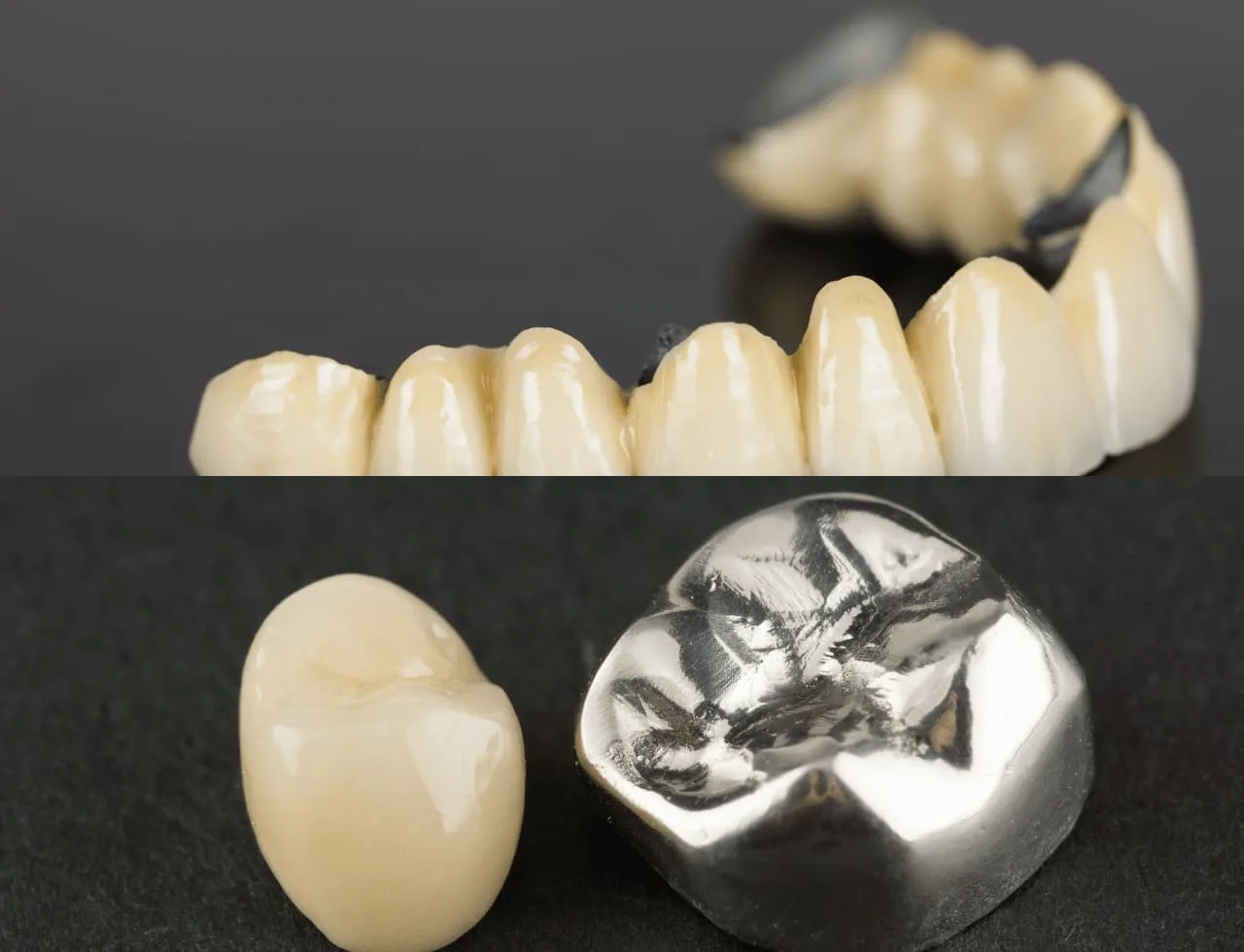
Porcelain Crowns & Bridges

Smilebook Dental Hyderabad — Porcelain crowns & bridges. In-house CAD/CAM. Free consultation.
✍️ Dr. Anurag Ellanki, B.D.S, M.D.S · 📅 Updated June 2026 · ⏱ 8 min read
Everything you need to know about porcelain crowns and bridges in Hyderabad — when a crown is the right treatment, which material to choose, how a bridge differs from an implant, the procedure at Smilebook Dental, and how long each restoration lasts.
What is a dental crown and when do I need one in Hyderabad?
A dental crown is a full-coverage porcelain restoration that fits over the entire visible surface of a damaged tooth. At Smilebook Dental Hyderabad, crowns are indicated when a tooth is too broken or decayed for a filling, after root canal treatment, to restore a cracked tooth, to cover a severely discoloured tooth, or as the final restoration on a dental implant. Crowns are fabricated in zirconia or e.max in Smilebook’s in-house CAD/CAM lab with a standard turnaround of 2–5 working days. Contact: +91 95159 61060.
What Is a Dental Crown — and When Is It Needed?
When does a tooth need a crown rather than a filling?
A tooth needs a crown rather than a filling when: the cavity is too large for a filling to restore adequate strength, after root canal treatment (the tooth becomes brittle without its internal pulp), a tooth is cracked through to near the root, a tooth is severely worn from grinding or acid erosion, or an existing large filling has fractured and the remaining tooth structure cannot support another filling. The threshold is structural — when the remaining sound tooth structure cannot support a filling’s bite forces reliably, a crown is the clinically correct restoration.
A crown works by covering the entire visible portion of the tooth — from the gum line upward — distributing bite forces evenly across the full surface rather than concentrating them on a weakened area. This is what makes it so effective for teeth that have lost significant structural integrity. The crown also seals the tooth from bacterial ingress at the margin, which is critical for teeth that have had root canal treatment.
What Is a Dental Bridge — and When Is It the Right Choice?
What is the difference between a dental crown and a bridge?
A dental crown covers a single existing tooth. A dental bridge replaces one or more missing teeth by using crowns on the adjacent teeth (called abutments) to support a false tooth (pontic) across the gap. The bridge is a single, connected unit that is permanently cemented — it does not come out. At Smilebook Dental, implant-supported bridges are often recommended as an alternative to conventional bridges, since they avoid preparing healthy adjacent teeth.
A conventional tooth-supported bridge is an appropriate choice when the teeth adjacent to the gap already need crowns themselves — in which case the bridge adds the replacement tooth without sacrificing additional healthy tooth structure. However, when the adjacent teeth are intact and healthy, a conventional bridge requires permanently grinding them down to accommodate the bridge abutment crowns — a significant sacrifice of healthy tooth structure that creates new potential failure points.
In most cases where adjacent teeth are sound, an implant-supported restoration is the more conservative and durable long-term solution. Dr. Anurag discusses both options honestly at your consultation, with the clinical recommendation based on the condition of your adjacent teeth and the amount of bone at the missing tooth site.
Materials — Zirconia, e.max, and PFM
Which is better — zirconia or e.max for dental crowns in Hyderabad?
Zirconia is the preferred material for most posterior crowns (premolars and molars) — superior strength at 1,200+ MPa handles heavy bite forces without the risk of veneer chipping. IPS e.max (lithium disilicate) is preferred for anterior crowns and veneers where translucency and natural light behaviour are the priority — strength is adequate for front teeth at 400+ MPa. At Smilebook Dental, Dr. Anurag recommends the most appropriate material based on tooth location, bite forces, and aesthetic requirements. All crowns are fabricated in the in-house CAD/CAM lab.
← Swipe to see full table
| Material | Strength | Aesthetics | Best For |
|---|---|---|---|
| Full-Contour Zirconia | 1,200+ MPa | Natural — no veneer layer | Posterior crowns, bridges, implant crowns |
| Layered Zirconia | 900+ MPa | High translucency | Anterior crowns, aesthetic zone |
| IPS e.max (Lithium Disilicate) | 400+ MPa | Best — most lifelike | Anterior crowns, veneers, inlays |
| PFM (Porcelain-fused-to-metal) | Excellent — metal core | Good — metal margin may show | Long-span bridges (where zirconia spans are too long) |
The Crown Procedure — Step by Step
Crown treatment at Smilebook Dental is completed across two appointments, typically 1–2 weeks apart. Between appointments, a temporary crown protects the prepared tooth and maintains aesthetics and function.
Consultation and Assessment
Dr. Anurag examines the tooth, takes digital X-rays to assess root health and bone levels, and confirms whether a crown is the most appropriate restoration. Where root canal treatment is needed before the crown, this is performed and healed before the crown preparation appointment.
Tooth Preparation and Digital Impression
Local anaesthesia is administered. The tooth is reshaped — removing a thin, even layer from all surfaces to create space for the crown. A digital intraoral scan replaces traditional moulds, capturing a precise 3D model of the prepared tooth, adjacent teeth, and opposing bite in minutes.
Temporary Crown and Lab Fabrication
A temporary crown is placed to protect the tooth until the permanent crown is ready. The digital scan is sent to Smilebook’s in-house CAD/CAM lab, where the crown is designed and milled in zirconia or e.max. Standard turnaround: 2–5 working days.
Crown Fitting and Cementation
The temporary crown is removed. The permanent crown is tried in for fit, bite, and shade before any cement is applied. Adjustments are made at the chair-side until Dr. Anurag and the patient are satisfied with the result. The crown is then cemented permanently with dental adhesive cement.
How Long Do Porcelain Crowns and Bridges Last?
How long do porcelain crowns last in Hyderabad?
Zirconia crowns at Smilebook Dental typically last 15–25 years with proper care. IPS e.max crowns last 15–20 years. PFM crowns typically last 10–15 years before the porcelain veneer layer may chip or the metal margin becomes visible due to gum recession. Longevity depends on oral hygiene, bite forces, and regular 6-monthly dental check-ups to detect any early margin issues.
Book Your Crown or Bridge Consultation
In-house CAD/CAM. 2–5 day turnaround. Free consultation. Two clinics across Bachupally and Gachibowli.
Porcelain Crowns & Bridges Hyderabad — FAQs
What is a dental crown and when do I need one? A crown is needed when a tooth is too damaged for a filling — after RCT, for large cavities, cracked teeth, or severe wear. At Smilebook Dental, crowns are fabricated in zirconia or e.max in the in-house CAD/CAM lab with a 2–5 day turnaround. Call +91 95159 61060.
Which is better — zirconia or e.max for dental crowns in Hyderabad? Zirconia for posterior teeth (maximum strength, no chipping risk). IPS e.max for anterior teeth and cases requiring maximum aesthetic precision. Both are fabricated in Smilebook’s in-house CAD/CAM lab. Dr. Anurag recommends based on tooth location and bite forces at your consultation.
What is the difference between a crown and a bridge? A crown covers a single existing tooth. A bridge replaces a missing tooth by using crowns on adjacent teeth to support a false tooth across the gap. At Smilebook Dental, an implant-supported restoration is often preferable to a conventional bridge when adjacent teeth are healthy — avoiding unnecessary preparation of sound teeth.
Smilebook Dental — Locations in Hyderabad
Opp Ramdev Jewellers, Mallampet Road · Mon–Sat 9AM–1:30PM & 3:30–9PM · Sun 10AM–7PM
Beside Radisson Hotel · Open 7 days · 11AM–8:30PM
Related Treatment Pages
RCT followed by a crown — the most common crown indication.
Implant-supported crowns — the preferred alternative to bridges.
Crown materials and attachment methods for implant restorations.
When a filling is sufficient — inlays and onlays for mid-sized cavities.
In-house CAD/CAM lab — how crowns are designed and milled.
Crowns as part of a comprehensive cosmetic smile transformation.
Full pricing reference across every treatment at Smilebook Dental.